
How do you predict how a vessel will perform in rough seas before it ever leaves the dock?
Understanding how a vessel behaves in waves is essential to safety, comfort, and performance. Seakeeping is both an art and a science, and while it has long been a core capability at Elliott Bay Design Group (EBDG), the team is refining its techniques to better predict vessel performance and stability.
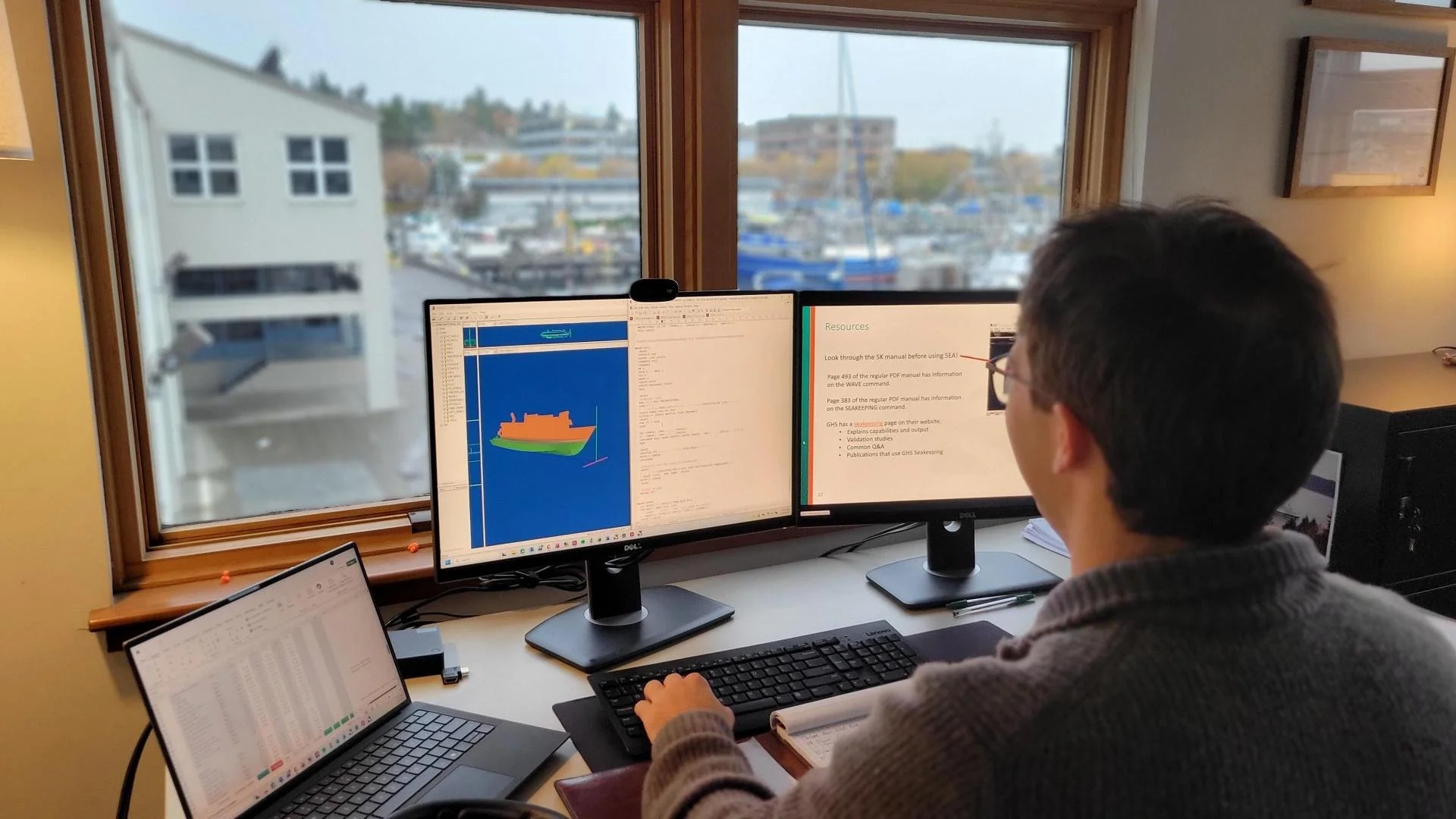
Our team now utilizes both ANSYS Aqwa, a powerful tool for modeling effects of dynamic loading on complex multi-body marine structures, and the GHS Seakeeping Module, which provides a quick, low-cost motions analysis for single, free-floating objects. This combination provides more options in simulating vessel motions and gives our engineers a more comprehensive toolkit for evaluating stability, comfort, and performance in real-world conditions.
What This Means for Our Clients?
EBDG can deliver refined simulations, broader capabilities, and deeper insight into vessel behavior at sea. Clients benefit from a more detailed understanding of motion, stability, and comfort earlier in the design cycle.
By pairing advanced software with decades of practical design and engineering experience, the team continues to develop safe, stable, and high-performing vessels that meet today’s evolving operational demands.
Learn more about how Elliott Bay Design Group applies advanced seakeeping analysis to modern vessel design at www.ebdg.com.